

If you use Nested Knowledge in a published review, you’ll want to cite your nest and describe your workflow. These details let readers assess and reproduce your methods.
A nest records your search, screening, tagging, and extraction decisions. Linking to it lets readers examine your process.
Citing your nest #
Link to your nest so readers can access your Synthesis. Open Synthesis, then copy the browser URL or select the Share icon in the top right.
Note: Your nest’s Synthesis must be public in order to freely share the link. See Nest Settings.
Link to the full Synthesis or a specific page, such as Qualitative Synthesis or Dashboard.
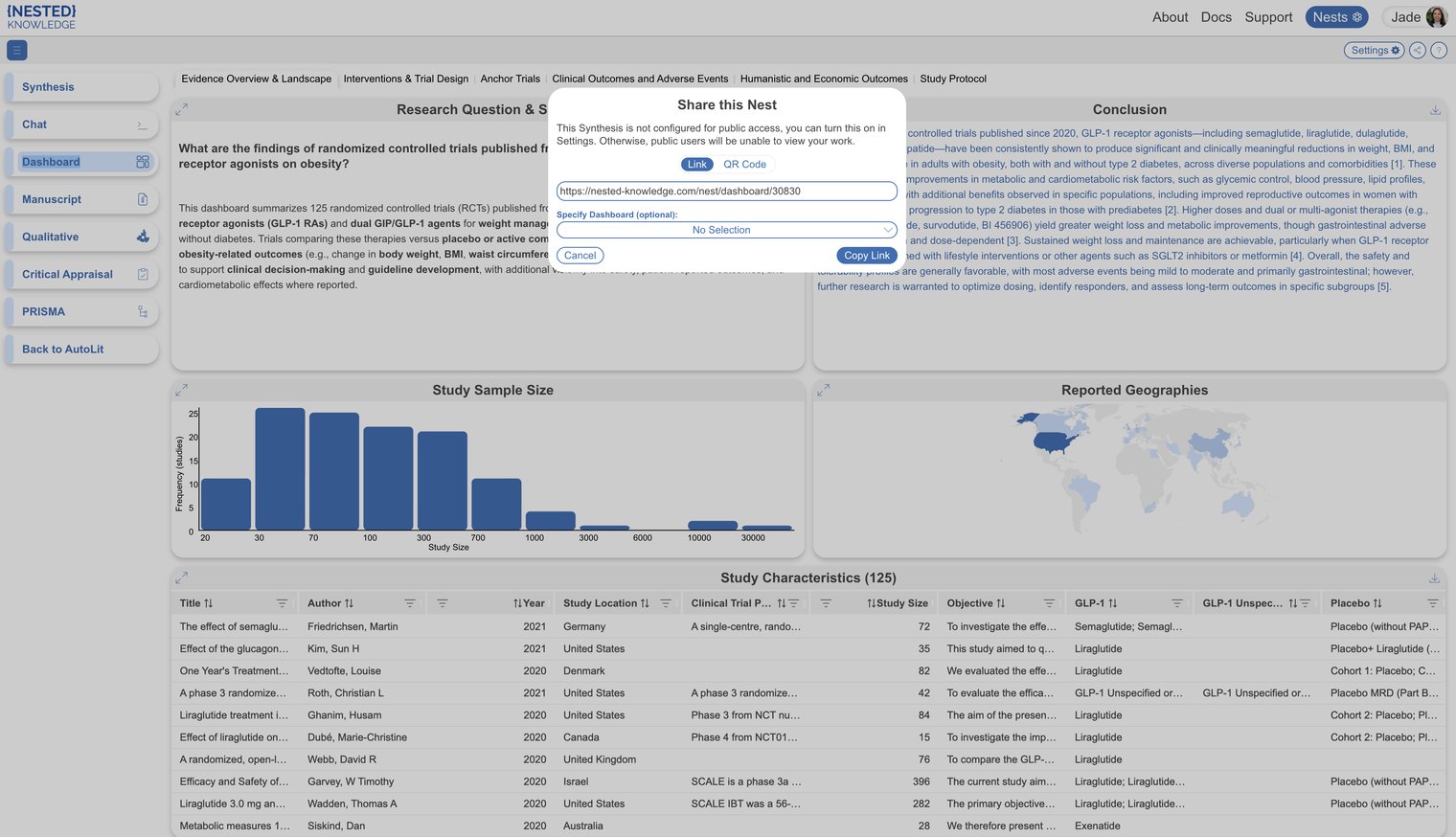
In your paper, link to the nest directly. For example: “The full results are available on our Synthesis page: [link to nest].”
In your references or bibliography, we recommend:
[Author last names and initials], et al. [Nest name]. Nested Knowledge. [link to nest]. Accessed [date].
For example:
Kallmes KM, Kallmes KR, Holub K, et al. COVID-19 RCTs – Phase I. Nested Knowledge. https://nested-knowledge.com/nest/212. Accessed September 14, 2021.
Journals use different reference formats. Include the nest name, Nested Knowledge, the link, and your access date.
Describing your methods #
Name Nested Knowledge and describe its role in your methods. State any AI-assisted steps clearly.
For a short mention, name the platform and the stages you used. For example: “We used AutoLit (Nested Knowledge, St. Paul, MN) for search, screening, and extraction, and Synthesis to visualize results.”
Add or remove stages to match your workflow. The company location is optional and depends on the journal.
For a fuller description, adapt the template matching your workflow. Complete every bracketed field.
Smart Nest #
An AI-assisted rapid review workflow.
Smart Nest method description
A rapid review was conducted using Smart Nest, an AI-assisted workflow within the Nested Knowledge evidence synthesis platform (Nested Knowledge Inc., St. Paul, MN, USA). Following refinement of the research question, Smart Nest generated and executed an AI-assisted PubMed search with Smart Search, screening eligibility criteria through Smart Screener using Criteria-Based Screening, data extraction with Adaptive Smart Tags, and critical appraisal with Smart Critical Appraisal. A human reviewer reviewed and verified AI-generated extraction outputs for included studies. Verified findings were narratively summarized using Smart Insights. The review methodology and outputs were compiled into a dashboard for visualization and interpretation.
Targeted literature review (TLR) #
An AI-assisted targeted review with sampled human checks.
TLR method description
A targeted literature review was conducted using the Nested Knowledge evidence synthesis platform (Nested Knowledge Inc., St. Paul, MN, USA). The review was guided by a predefined research question and targeted eligibility criteria developed to identify evidence relevant to the review objective.
An AI-assisted search strategy was generated using Smart Search, which identifies search concepts, terms, and Boolean combinations from the predefined research question. It was executed in [a connected literature database] through an application programming interface (API). Retrieved records were screened for eligibility at the title and abstract [and full-text] level(s) using Criteria-Based Screening. Smart Screener filled one reviewer seat, alongside a second, human reviewer and a third, human adjudicator. Relevant data were extracted using Adaptive Smart Tags (ASTs). Tags are the core unit of data capture. Here, ASTs configured extraction data fields. A human reviewed the AI-generated screening decisions and extracted data. Following extraction, evidence from included studies was synthesized into an interactive Dashboard with tables, diagrams, and Smart Insights.
Systematic literature review with dual screening #
A systematic review with Robot Screener and human review.
Systematic literature review with dual screening method description
A systematic literature review was conducted using the Nested Knowledge evidence synthesis platform (Nested Knowledge Inc., St. Paul, MN, USA). The review followed a predefined protocol. Literature searching was conducted in [database(s)] from [dates]. The search strategy was [generated/developed/refined] using Smart Search, which generates search concepts, terms, and Boolean combinations from the research question.
Following deduplication, retrieved records were screened at the title and abstract level using a dual screening workflow. Robot Screener filled one reviewer seat. A second, human reviewer and a third, human adjudicator completed the workflow. Robot Screener was initially trained on [a minimum of 50 adjudicated records]. The adjudicator evaluated discordant decisions and made the final eligibility determination. Potentially eligible full-text articles were independently assessed by two human reviewers against the predefined eligibility criteria. Disagreements were resolved through discussion or adjudication by a third human reviewer, and reasons for exclusion were documented.
Data were extracted from included studies using Adaptive Smart Tags (ASTs). Tags are the core unit of data capture. Here, ASTs configured extraction data fields. The extraction framework and tag-specific prompts were [piloted and refined on # studies] before full implementation. A human reviewer checked all AI-generated extraction outputs against the source publication before synthesis.
Included-study data were displayed in the Synthesis Dashboard, using structured tables and figures. Smart Insights generated narrative summaries from data extracted through ASTs. A human reviewer [reviewed/edited/approved] the summaries and checked them against the underlying evidence.