Introduction
The volume, complexity, and fast-moving nature of medical research complicates the synthesis of findings and literature. The conducting of systematic literature reviews (SLRs), network meta-analyses, and other evidence syntheses are time and labor intensive. Artificial Intelligence (AI) tools, particularly those that use Large-Language Models (LLMs), are looked to as a way to ease the burden of such analyses, as they provide an efficient way to pull in information, structure it, and generate high-level summarizations.
Modern AI tools embed LLMs within a system called a “harness” that gives the LLM context management capability and the ability to take actions (e.g. reading and writing files). These systems are commonly called agents and can be used in evidence synthesis for a variety of tasks. For instance, one can use an AI agent to create data extraction templates that the agent fills in or can use an agent to download a RIS file, convert it to a data table of titles and abstracts, and have the LLM read the table to make inclusions/exclusion decisions.
However, this flexibility can obscure the degree to which LLMs’ effectiveness differs based on the “harness” and workflow they are embedded in. Specialized tools like Nested Knowledge addresses limitations of LLMs by providing a harness tailored to the evidence synthesis workflow. In the case of Nested Knowledge, this includes full traceability for any AI extractions, in-review validation metrics, human-in-the-loop approval and audit capabilities, the ability to share living reviews that can be automatically updated and shared, copyright and usage rights compliance and improved tabular data extraction. Meanwhile, the LLMs used and LLM interactions within Nested Knowledge are built, monitored, and constantly improved with respect to SLR-specific workflows, unlike generalist agentic tools.
Nested Knowledge vs. Desktop Agents (e.g. Claude)
Literature Review Capabilities: | NK | LLM Agent |
|---|---|---|
Ergonomics | ||
Structured Workflows | Yes | No / ad hoc |
Customizability of workflows | Yes | Very |
Configuration by user | Required, detailed | Minimal, high-level |
Collaborative across team | Yes | No |
Sharable outputs | Yes | Yes but, static |
Updatable, Data Durability | Yes | Hard |
AI Capabilities | ||
Traceability to source documents | Yes | Difficult / weak |
Auditability, human oversight and editing | Yes | Ad hoc |
Accuracy of automations | Good | Good |
Reading of difficult source materials (e.g. scans, figures) | Good | Good |
Quantitative Evaluation of Automation Performance | Yes | No / ad hoc |
Benchmarking in the SLR space | Yes | No |
Data Management | ||
Versioning | Yes | No |
Integrations | Yes | Ad hoc |
Backups | Yes | No / ad hoc |
Enterprise Security | Yes | No |
Usage Rights | Yes | Hard |
Support | ||
Training/Knowledge Requirement | High | Low |
Support | People | No |
Product Feedback taken and developed | Yes | No |
Table A: Feature comparisons between Nested Knowledge and General AI Agents
Efficacy and Accuracy Improvements over General Agents
Improved Performance with Specialized Tools
One of the most important benefits to using specialized tools is that they sometimes can be shown to perform better on traditional accuracy and classification metrics. Although tools like Nested Knowledge may use the off-the-shelf OpenAI or Claude model as the LLM model in its workflow, its “harness” creates improved performance.
For example, forthcoming research from our team analyzed the performance of Claude (Max, Opus4.7) against Nested Knowledge (NK; v1.111, high fidelity mode) on accuracy in data extraction across five lung cancer trials for study and patient characteristics and efficacy outcomes. Although both tools exhibited high accuracy for study and patient characteristics, extraction of efficacy outcomes showed better performance for Nested Knowledge, with 79.6% of extractions correct under Nested Knowledge, compared to 68.3% for Claude. After accounting for missed subgroups by treatment arm, performance declined to 39.3% and 19.4%, respectively. Claude also showed greater variation across studies, with weaker performance in later-positioned outputs.
Despite Nested Knowledge using an OpenAI LLM, and not a proprietary model, its harness allows the application to see performance improvements. For example, Nested Knowledge is optimized to produce a massive number of data point extractions, one at a time. This is in comparison to other agents, which may group up point extractions within a study or even across studies in arbitrary ways. Nested Knowledge also leverages cutting edge document extraction to machine readable formats (“High Fidelity Mode” in the software). Additionally, work has been done to optimize the harness for gathering and structuring the relevant/correct user input configuration and surfacing this high-relevancy information to the LLM to provide more precise instructions (e.g. column-level instructions, content types).
Nested Knowledge’s Synthesis module, which includes various tools for summarizing and analyzing studies that have been screened and have had their data extracted, also can have benefits over general AI agents through careful use of the context window budget. Documents and texts provided to an LLM become part of that model’s “context window”. LLMs can pay more quality attention to data in their “context window”, resulting in improved accuracy on questions using specifically provided data versus relying on extraneous study data or its summarizations from context compaction. In the case of Nested Knowledge, Synthesis functions like Smart Insights and Synthesis Chat do not place the whole underlying study text into the LLM’s context-window, but instead extracts the relevant data into the LLM’s context window. This helps prevent the performance decline that can be seen by over-populating the context window.
Improved Traceability and Avoidance of Fabricated References
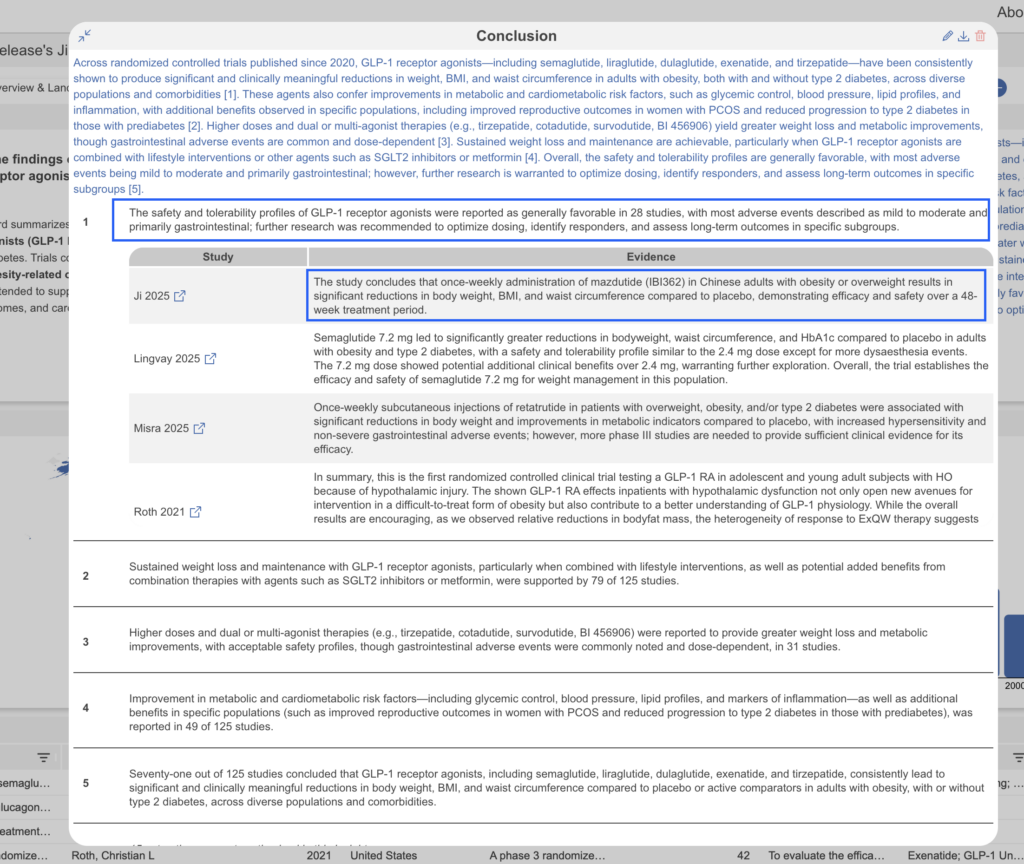
Specialized tools can help avoid fabricated references and lack of traceability of claims to underlying study text by keeping LLMs limited to insight generation based on included study data within a review. As noted above, having the tool focus on provided in-context data boosts performance. This includes utilizing techniques to limit an LLM’s summarization to those studies included in the literature review. This can include ensuring traceability, where any insight is tied to a specific quotation from the underlying study text. For example, when Nested Knowledge’s AI features returns a quote from the underlying source, the application uses deterministic matching for that actual text in the source, taking into account whether the LLM paraphrased or shortened the quote. An exact position of the quoted text is returned back to the user, thanks to every character and its exact position having been mapped by another element within the harness dedicated to this. Internal validation studies of the Nested Knowledge tool shows a 99% success rate linking the LLM’s rationale and citation to the underlying document. The image below outlines an example of how this works with the Smart Insights function, which allows an AI agent to develop analytic insights – with traceability to quotations in underlying studies.
Validation Within Review Metrics
Specialized tools like Nested Knowledge can also provide performance validation of inclusion and exclusion decisions within the review, in line with RAISE and other AI usage guidance for evidence synthesis. Nested Knowledge provides evaluation metrics in its Smart Screener module, where human reviewer inclusion/exclusion decisions are automatically compared to the LLM’s screening decisions to generate accuracy, precision, and recall metrics for evaluating performance. Tagging and Critical Appraisal functions will also soon support said evaluation metrics within the review. Additionally, the traceability of all claims and insights from Smart Insights and Synthesis Chat, and the traceability of all data tag extractions to data in underlying studies, allows for further validation within the review.
Copyright Compliance and Management
A major point of concern in AI usage includes copyright and AI usage rights compliance at the journal and literature database level, with attention paid to both abstract and full-text usage rights. Specialized tools can help ensure this compliance. Nested Knowledge provides a Usage Rights Management module, including both an automated CCC RightFind integration as well as the ability to manually designate usage rights to be applied and followed for studies and abstracts, based on which literature database they are taken from. This includes AI usage rights at the abstract level. Nested Knowledge guarantees usage rights compliance where general purpose agents choose to comply.
Living Reviews and Collaboration
A final function Nested Knowledge can provide over general AI agents is its ability to serve as a platform for living reviews and collaboration among researchers. Automatic Search allows searches to be run on regular intervals to pull in new studies for screening, with PRISMA diagram and Synthesis updated accordingly. Smart Screening can be used to screen new studies automatically, with AI-assisted tagging pulling in data extractions. Synthesis pages can also be publicly shared with others, without requiring a subscription to access, facilitating hosting public live reviews or collaborative efforts.
Conclusion
LLMs are powerful tools and their careful use can greatly accelerate the evidence synthesis process. Tools like Nested Knowledge are specifically designed for harnessing that power into a systematic literature review workflow that is traceable, validated, and human curated.
A blog about systematic literature reviews?
Yep, you read that right. We started making software for conducting systematic reviews because we like doing systematic reviews. And we bet you do too.
If you do, check out this featured post and come back often! We post all the time about best practices, new software features, and upcoming collaborations (that you can join!).
Better yet, subscribe to our blog, and get each new post straight to your inbox.

How Smart Study Type Tags Are Reinventing Evidence Synthesis
One of the features of Core Smart Tags is Smart Study Type – this refers to our AI system that automatically categorises the study type