
Blog

How Smart Study Type Tags Are Reinventing Evidence Synthesis
One of the features of Core Smart Tags is Smart Study Type – this refers to our AI system that automatically categorises the study type
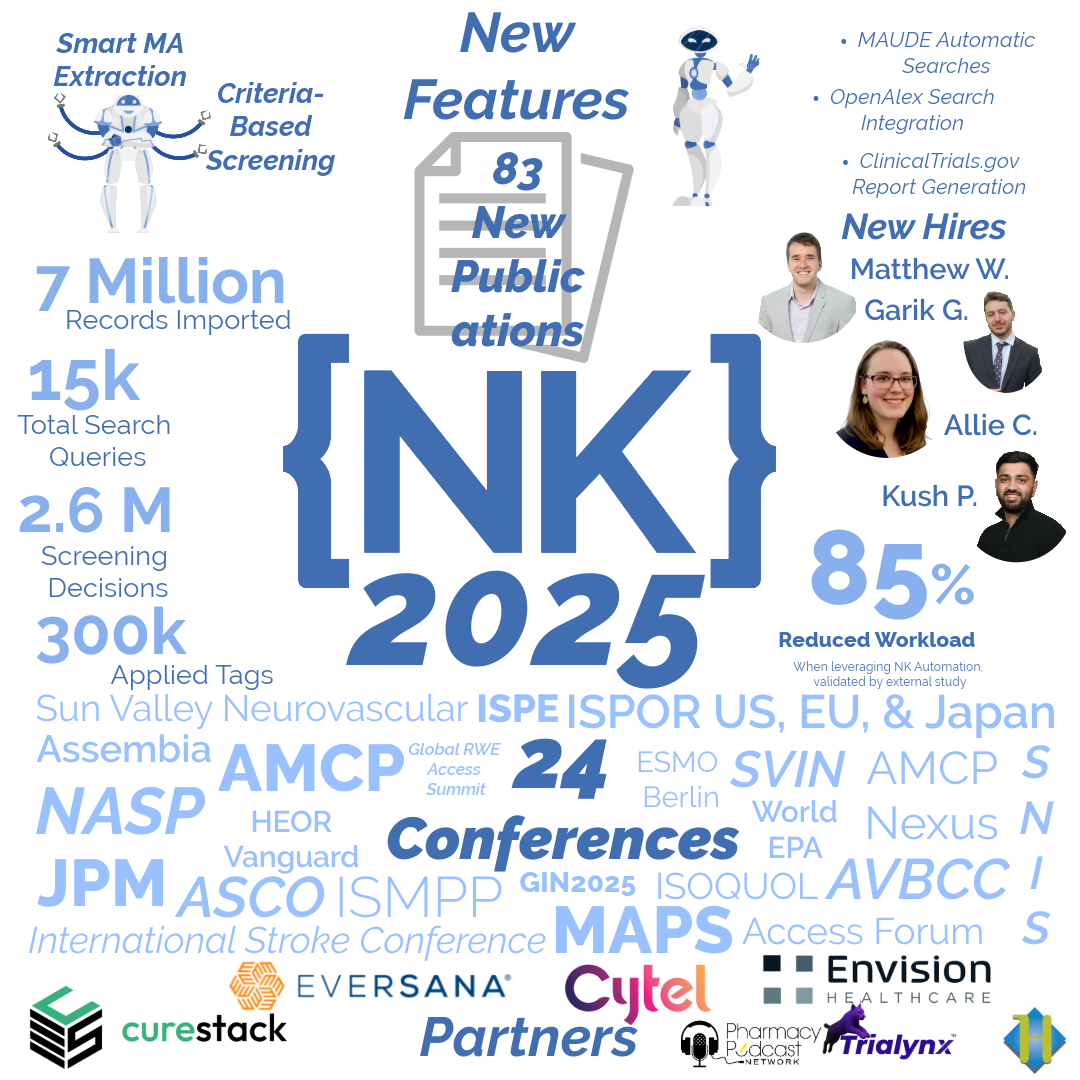
As 2025 comes to a close, Nested Knowledge reflects on a year defined not just by growth, but by validation. This was the year our vision for AI-enabled evidence generation moved decisively from promise to proof. At the heart of that progress was a wave of major product innovation, focused on making evidence discovery, surveillance, and synthesis faster, broader, and more reliable.
We significantly expanded how teams find and monitor evidence. With MAUDE Automatic Searches, ClinicalTrials.gov report generation (individual and bulk), and OpenAlex search integration, Nested Knowledge now supports continuous, multi-source evidence discovery across safety, clinical trials, and the broader research landscape. Together, these capabilities reduce manual monitoring, expand coverage beyond traditional databases, and ensure that emerging signals and trial data are captured early, consistently, and transparently.
We also pushed the frontier of AI-assisted synthesis and analysis. Smart MA Extraction accelerates meta-analytic workflows while preserving traceability back to source data, helping researchers move faster without sacrificing methodological integrity.
Screening and appraisal saw equally meaningful advances. Criteria-based screening and Smart Screener introduced intelligent prioritization into one of the most time-intensive stages of evidence review, while dual critical appraisal strengthened reproducibility and alignment with evolving global standards. Together, these features represent a shift from isolated automation to a truly connected, end-to-end evidence platform.
Importantly, this year also brought independent external validation. From Macej Grys, researchers presented findings demonstrating how Nested Knowledge performs in real-world, methodologically rigorous settings, offering rare, public evidence that AI-driven workflows can be transparent, reliable, and aligned with best practice.
You can find the link to the poster here: Validation Poster
It was found that Nested Knowledge Automation reduced workload by an average of 85% in key steps, while maintaining or surpassing human-level accuracy. How fantastic is that?
Our work, and its impact, was shared across the global healthcare ecosystem. In 2025, the Nested Knowledge team presented, demonstrated, and contributed at leading forums including ISPOR (US, EU, Japan), AMCP Nexus, ASCO, MAPS, SNIS, SVIN, Access Forum, NASP, AVBCC, and many more, alongside presence at JPM, ESMO Berlin, ISMPP, ISOQOL, HEOR Vanguard, and global RWE and policy summits.
We strengthened our ecosystem through strategic partnerships with Cytel, Envision, Health Analytics, Curestack, TrialLynx, EVERSANA, and the Pharmacy Podcast Network, expanding how evidence supports decision-making across HEOR, access, clinical development, and education.
Nested Knowledge’s growth continued across the board with our internal metrics showing:
In 2025, we recorded over 15,709 total search queries, imported over 7 million records, 2.6 million screening decisions, over 300,000 applied tags, and over 1,000 critical appraisals completed. Those are all new records for NK usage!
Today, the platform supports over 15,801 total users across a rapidly expanding set of organizations spanning pharma, biotech, CROs, consultancies, and academic institutions, powering millions of screening decisions and helping teams turn overwhelming volumes of literature into structured, defensible insight.
We also welcomed four new employees to help further our research and internal policies. We brought on Kush Patel and Garik Galustjan to enhance how clients leverage Nested Knowledge and Allie Chichewicz to be the leader of our research team. Last but not least, Matthew Williams was signed on as our new operations manager. All have paid dividends in 2025 and are essential pieces for our future growth.
Finally, 2025 brought meaningful recognition. Nested Knowledge was awarded an NIH SBIR grant to advance AI-powered quantitative data extraction, affirming the scientific importance of our work. And our President, Keith Kallmes, was named to 40 Under 40 in cancer, recognizing leadership that is shaping not only our company, but the future of evidence generation itself.
This year wasn’t just about shipping features or attending conferences. It was about earning trust through transparency, validation, and real-world impact.
We’re proud of what we built in 2025. And we’re just getting started.
Yep, you read that right. We started making software for conducting systematic reviews because we like doing systematic reviews. And we bet you do too.
If you do, check out this featured post and come back often! We post all the time about best practices, new software features, and upcoming collaborations (that you can join!).
Better yet, subscribe to our blog, and get each new post straight to your inbox.
One of the features of Core Smart Tags is Smart Study Type – this refers to our AI system that automatically categorises the study type